

Baby sleep
A simple baby sleep log that you will actually keep using
Quick answer
The simplest useful baby sleep log records the date, when sleep began, how long it lasted, and an optional one-line note. Keep the method consistent, add missed entries later when you can, and review several days as a memory aid rather than judging one nap.
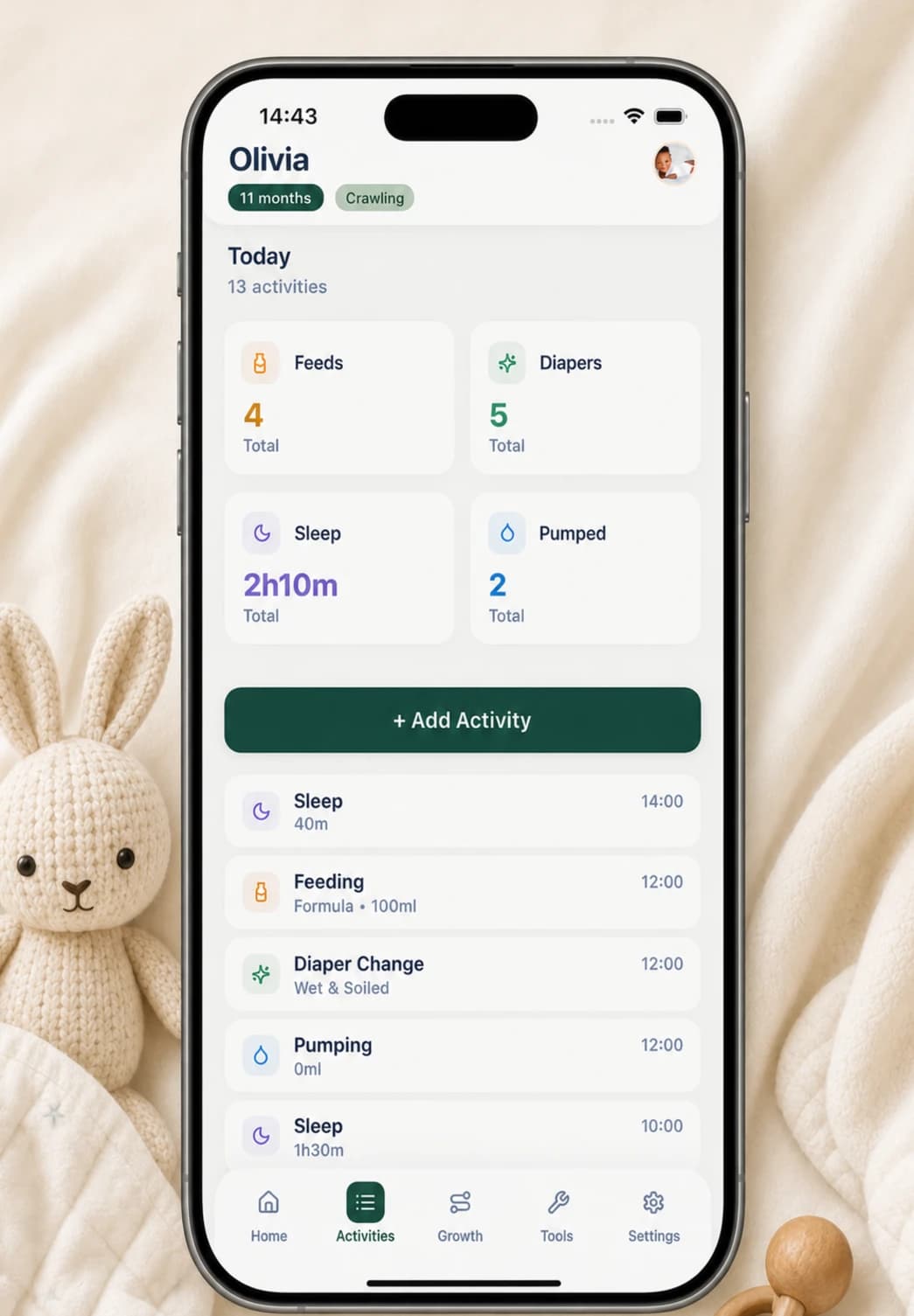
Use four fields, not a sleep diary questionnaire
For most day-to-day handoffs, the useful facts are the date, sleep start, duration or end time, and a short note only when something changed the context. A smaller form is easier to complete at night and easier to scan the next morning.
Decide what counts as the start of sleep for your family and use that definition consistently. Exact-to-the-minute data is rarely realistic during a busy day; a clearly approximate entry is more honest than invented precision.
- Date: especially important when adding the entry later.
- Start: the time you consider the sleep period to have begun.
- Duration or end: use one consistent way to calculate the length.
- Note: reserve it for context such as travel, illness, or an interrupted nap.
A low-friction Buggy workflow
In Buggy, tap the Sleep card on the Home screen, enter the duration and start time, and add a note only if it will help later. If the sleep happened on an earlier day, use the retroactive date option instead of trying to force it into today.
After saving, the Home screen updates today's recorded sleep total and the time since the latest sleep entry. The activity history keeps the individual entry available for review or correction. Buggy stores the activity locally and does not require an account or sync it to another caregiver's phone.
- Log immediately when it is easy.
- Catch up later when immediate logging would interrupt care or rest.
- Correct an entry rather than keeping a known error for the sake of a streak.
- Leave an unknown period unknown instead of estimating more precisely than you remember.
Review the log in three questions
A quick review should reduce mental load. Ask when the most recent sleep ended, what the recorded day looked like overall, and whether there is a concrete detail another caregiver or clinician needs to know. You do not need to assign a quality score to every sleep period.
Several days of consistently recorded entries can make a routine easier to describe, but there is no magic number of days that turns a home log into a diagnosis. Buggy's PDF export summarizes recorded activity over the last seven and 30 days, while the CSV contains individual activity rows for a more detailed handoff.
Treat gaps and unusual days as context, not failure
Babies, days, and family schedules vary. Travel, feeds, illness, noise, development, and changes in care can all make one day look different. A missed nap entry or an unusual night does not invalidate the rest of the record.
If logging starts to increase anxiety or keeps someone focused on the phone instead of the baby, simplify it or pause. The purpose is to remember useful facts. It is not to prove that a baby followed a schedule.
Do not use the log to make a health conclusion
Sleep-duration recommendations describe broad age groups and still vary with individual biology. A home log can show what you recorded, but it cannot explain a change, diagnose a sleep condition, or determine whether a baby is getting an appropriate amount of sleep for their circumstances.
Bring the record to a qualified pediatric professional when it helps you describe a concern, but do not delay care while collecting more data. If something feels urgent, use the appropriate local medical or emergency service.
Safe sleep is a separate checklist every time
The time or duration written in a sleep log says nothing about whether the environment is safe. CDC guidance says to place infants on their back for naps and nighttime sleep, use a firm and flat sleep surface intended for infants, and keep soft bedding and soft objects out of the sleep area.
Use those recommendations and any individual clinician instructions for every sleep. Buggy is a record, not a baby monitor, breathing monitor, or safety system, and no completed entry prevents sleep-related harm.
Questions, answered plainly
What should I include in a simple baby sleep log?
Record the date, sleep start, duration or end time, and an optional short note. Consistent definitions matter more than adding many fields or pretending every time is exact.
Do I need to record every nap?
No. Record what is useful and sustainable for your family. If you miss an entry, add it later when you remember or leave the gap visible; do not let completeness become more important than care or rest.
How many days does it take to find a sleep pattern?
There is no fixed number that makes a home log medically meaningful. A few consistent days can help you remember and describe the routine, while longer summaries may give more context. Neither establishes a diagnosis.
Can I add an earlier sleep entry in Buggy?
Yes. Buggy's add-activity form lets you choose a past date, enter the sleep start time and duration, and add an optional note. The entry can be reviewed and corrected afterward.
Sources and further reading
- Providing Care for Babies to Sleep SafelyCenters for Disease Control and Prevention
- Child Sleep Duration Health AdvisoryAmerican Academy of Sleep Medicine